Welcome to the training school - Best Practices for Accounting for Biological Sex in (Transcript)OMICS Studies!
August 24th and 25th at the DKFZ in Heidelberg, Germany
This two day workshop will cover the basics needed to incorporate sex into your data analysis and give you time to work on your own dataset with guided expertise. If you do not have your own data set, one will be provided to you. Basic knowledge of R is required.
Description
Does sex really matter when planning a biomedical research project?
Should experiments always include both males and females in each experimental group? How can we design studies in practice while balancing experimental and ethical constraints, controlling costs, and maintaining sufficient statistical power to detect other biological effects of interest? And will accounting for sex make the analysis more complicated for bioinformaticians?
In this workshop, we will focus on biological sex as a key variable in biomedical research, discussing practical considerations for both experimental design and data analysis. Together, we will explore the concept of biological sex, examining questions such as whether it can truly be considered a binary variable and how it differs from gender, and discuss how its biological complexity can influence research outcomes.
The workshop will combine case studies with guided hands-on exercises using transcriptomics datasets, providing participants with practical tools to integrate sex as a biological variable in their analyses.
Key questions addressed during the workshop will include:
- How can transcriptomics datasets be analyzed appropriately while accounting for sex as a biological variable?
- How can potential sex-related biases in datasets be identified and corrected where possible?
- How can we detect genes showing interactions between sex and other factors of interest (e.g., treatments or environmental conditions)?
- How can different analytical choices influence the conclusions drawn from the data?
Hands-on sessions
These are practical sessions in which you will run Quarto/R notebooks on your own computer. There are four:
- 02a — Experimental design and power simulation This is a pure simulation exercise requiring no sequencing data. We will generate synthetic cohorts, fit simple linear models and repeat the experiment thousands of times to measure power directly. This session addresses head-on the misconception that including both sexes doubles your sample size, and shows why an interaction term costs far more power than a main effect
- 02b — GTEx liver exploration (sex and age) Applies the concepts from the previous exercise to the analysis of a real RNA-seq dataset from the GTEx project using DESeq2.
- 03a/b — GTEx multi-tissue sex interaction Interaction models across tissues using limma/edgeR and DESeq2, on a larger dataset, where the practical difficulties become apparent.)
- 04 – COVID vs non-COVID lung samples Disease-sex interaction analysis, staged FDR, and global effects
You can find the data and notebooks here.
We are looking forward to your registration!
The Organizing Committee
CHAIRS / PROGRAM COMMITTEE
Stefania Del Prete, Fiona Brown-Burke, Ivana Jaric
PROGRAM
Confirmed Trainers
Anagha Joshi University of Bergen, Norway
Vidhya Jagannathan University of Bern, Switzerland
Stefania Del Prete The German Cancer Research Center (DKFZ), Germany
Pierre-Luc Germain ETH Zürich, Switzerland
Silvia Calderazzo The German Cancer Research Center (DKFZ), Germany
Benjamin Phillips Astrazeneca, UK
Julien Roux University of Basel, Switzerland
Belén Otero Carrasco The German Cancer Research Center (DKFZ), Germany
Cristina Conde López The German Cancer Research Center (DKFZ), Germany
VENUE AND HOW TO GET THERE
The Conference will take place in person in the K1/K2 room (upstairs) in the communication center at the DKFZ.
Im Neuenheimer Feld 280
69120 Heidelberg Germany
German Cancer Research Center (DKFZ) — Communication Center Im Neuenheimer Feld 280, 69120 Heidelberg Phone (reception): +49 6221 420
The Communication Center is inside the DKFZ main building (INF 280), on the ground floor near the main entrance. Please come to the main entrance and follow the signs to the Communication Center; the information desk in the entrance hall can help if you are lost. Note that DKFZ is in Neuenheimer Feld, one of the largest scientific campuses in Europe, so allow a few minutes to find the right building among many similar ones — the house number is displayed at the top of each building, and ours is 280.
From Heidelberg main station to DKFZ
All options below start at the tram/bus stops directly in front of the station.
- By tram (recommended) Take tram line 21 or 24 towards Handschuhsheim and get off at "Jahnstraße". From there it is a 5-minute walk: continue along Jahnstraße past the barrier into the clinic campus, then follow Kirschnerstraße for about 100 m — the DKFZ main building is the tall building on your right.
- By bus Take bus line 20 or 32 in the direction of Neuenheimer Feld and get off at "Kirschnerstraße", which is the closest stop to the main building (about a 3-minute walk).
- On foot (about 15 minutes) Leave the station heading north and cross the four-lane Kurfürsten-Anlage. Follow Mittermaierstraße over the Neckar. Roughly 100 m after the bridge, turn left into Jahnstraße and follow it to the barrier at the clinic campus entrance. Pass the barrier and continue along Kirschnerstraße for about 100 m; the main entrance is on your right.
From the city centre (Bismarckplatz)
- Lines 21 and 32 also run from Bismarckplatz — about 5–10 minutes to Jahnstraße / Kirschnerstraße. If you are staying in the Altstadt, Bismarckplatz is the natural interchange point.
Tickets
Local transport is run by rnv (Rhein-Neckar-Verkehr). A single ticket within Heidelberg costs roughly €3, and a day ticket is worth it if you plan to move around. Buy at the machines at the stop, or use the rnv/VRN mobile app. Live timetables: rnv-online.de/fahrtinfo. The Deutschlandticket, if you already have one, is valid on all of these.
By car
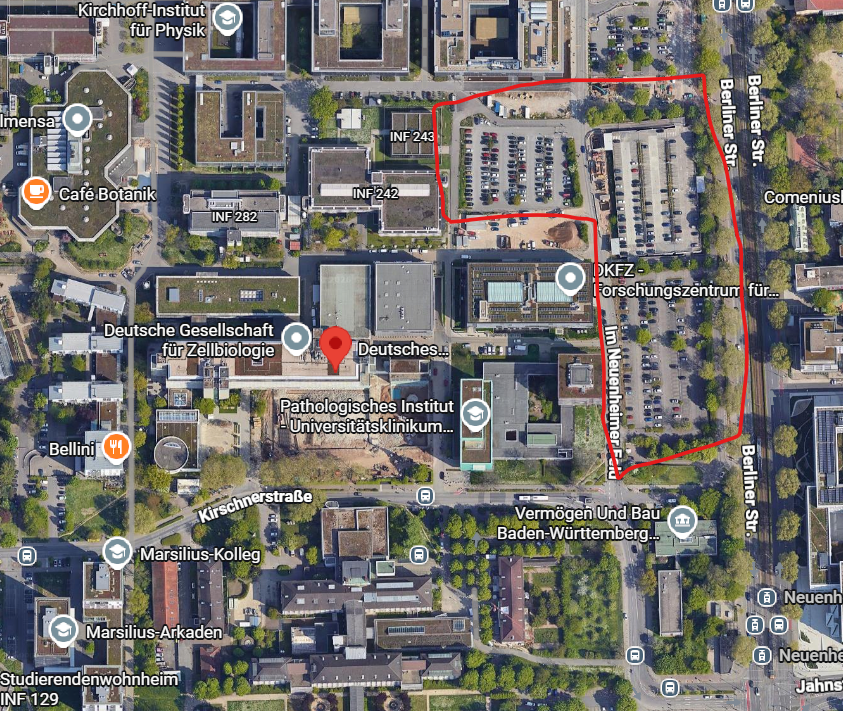
Due to the limited number of parking spaces in Neuenheimer Feld, we recommend using public transportation. If you are able to park on Neuenheimer Feld (see circled lots below), your ticket can be validated at the front desk of the DKFZ. If you are unable to find parking in our lots, the public parking garage P25 is about a 10-minute walk from the DKFZ. Click here for more information.
TRAVEL AND ACCOMMODATIONS
Participants are expected to cover their travel, hotel, and food costs. The workshop covers coffee breaks and lunches for August 24th and 25th.
Supported participation is available for a select number of participants up to 850 Euro total. To apply please, use the application tab on the left hand bar.
ACCESSIBILITY
ORGANIZER

This event is subject to the DKFZ data protection policy
IN COOPERATION WITH
The training school is co-organized by the EU-SABV COST Action (CA24168), the European Initiative to Enhance the Current SABV Policy in Preclinical Biomedical Research, funded by the European Cooperation in Science and Technology (COST). Learn more about the EU-SABV COST Action on the action webpage.