WELCOME to the TelomereHunter2 Workshop!
TelomereHunter2 is a tool for sequence-based telomere analysis that measures telomere content and composition. As input, it requires sequencing data in BAM or CRAM format, and supports a wide variety of sequencing protocols. Originally developed for cancer genome analysis in humans, it has been expanded for comparative analysis of vertebrate genomes and addressing research questions in the fields of immunology and aging. TelomereHunter2 now also supports single-cell analysis.
What are telomeres?
Telomeres are specialized nucleoprotein structures that protect the ends of linear chromosomes from degradation, recombination and unwanted DNA repair activities. They comprise of repetitive DNA sequences (TTAGGG in humans), bound by specific shelterin proteins. They shorten with each cell division due to the end-replication problem, until reaching the Mortality stage 1 (also known as the Hayflick limit), resulting in cellular senescence or apoptosis.
Why are they interesting?
The state of telomeres can provide insights into cellular aging, genome maintenance and its stability. Telomere analysis is especially important in cancer research, where the activation of telomere maintenance — either through telomerase or alternative lengthening mechanisms (ALT) — allows the cells to proliferate indefinitely. Identifying the telomere lengths and maintenance mechanisms can have an impact on both diagnosis and therapy.
How to study telomeres?
Aside from wet lab experiments, telomere content can also be determined from sequencing data. TelomereHunter2 is compatible with many types of sequencing data, including whole genome sequencing, low coverage WGS, exome sequencing, ChIP-seq, long-read sequencing data. It now also supports data from single-cell experiments.
Aim of the course
In this ~3 hour course, we aim to familiarize you with the use of the TelomereHunter2 software, the interpretation of the output, and the different insights the abovementioned data can provide. The course will consist of a short theoretical background, followed by a hands-on session covering the installation, use, and test run of the software. Guided results interpretation will help participants identify the telomere content and discern the telomere maintenance mechanism of the examples. Further breakout sessions will focus on the application of TelomereHunter2 to more specific scenarios, such as single-cell data or non-human genomes.
Target audience
This workshop is aimed at PhD candidates, postdocs, software technicians, (graduate) students, and other researchers or staff interested in telomere analysis. Both academic and non-academic participants are welcome.
Participation in this workshop is free of charge.
Prerequisites
A basic knowledge of bioinformatics and genomics is required, as well as familiarity using command-line tools.
Participants must bring their own computers to participate in the hands-on session. Note that there are some known compatibility issues within the Windows environment. A Linux or macOS device is recommended.
The software requires python ≥ 3.8. For more information, see the TelomereHunter2 GitHub page.
Publications
TelomereHunter2 and its predecessor have been used in many studies and research fields. For more information, see the following publications.
-
The TelomereHunter tool:
https://doi.org/10.1186/s12859-019-2851-0 -
Pan-cancer study:
https://doi.org/10.1038/s41467-019-13824-9 -
TERRA analysis via RNA-seq in childhoold neuroblastoma:
https://doi.org/10.1038/s41467-021-21247-8 - Single-cell resolution of telomere content in immune cells (preprint):
https://doi.org/10.1101/2024.08.28.609339
We are looking forward to your registration!
HOSTS/PRESENTERS
 |
 |
 |
| Dr. Lars Feuerbach | Urška Pogorevčnik, MSc | Ferdinand Popp, PhD Student |

VENUE
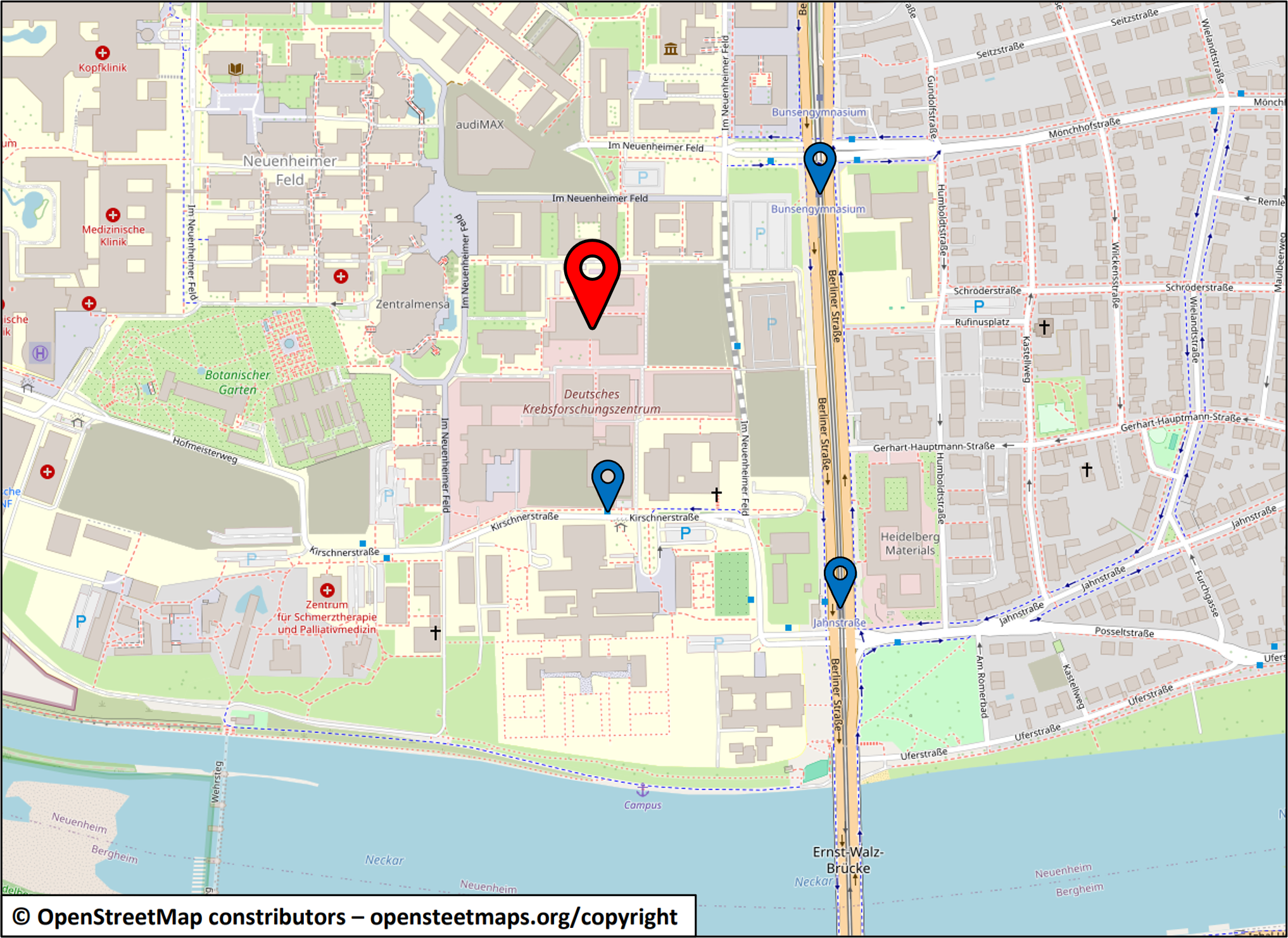
The workshop will take place in the seminar room A0.106 at the DKFZ ATV/IIC Building, ground floor.
Display location in Google Maps
Address (marked red):
Im Neuenheimer Feld 242
69120 Heidelberg
Access with public transport (marked blue) via stops Kirschnerstraße, Jahnstraße, or Bunsengymnasium.
ORGANIZER

This event is subject to the DKFZ data protection policy
IN COOPERATION WITH